Si solo te sale con tu pareja, todavía no sabes guiar
En nuestras clases de salsa en pareja rotamos. Siempre hay alguien que pregunta si no sería mejor quedarse con la misma persona, porque "con ella ya me sale". Justamente por eso rotamos: si una figura solo te sale con una persona, lo que aprendiste es a bailar con esa persona, no a guiar.
Rotar no es bajar de nivel. Es todo lo contrario: es donde de verdad se aprende a bailar en pareja.
El error: aplicar las mismas figuras a todo el mundo
A medida que avanzamos, queremos sumar cosas. Más vueltas, más figuras, más brazos, todo más fluido. Y muchas veces se las hacemos igual a todas las personas con las que bailamos, a la misma velocidad y con la misma fuerza, como si fueran la misma.
Ahí nos olvidamos de lo más importante: la persona que tenemos delante. No todas van a tu ritmo, no todas giran igual y no todas conocen las mismas figuras. Si aceleras para que te salga todo, la otra persona se queda atrás y el baile se rompe.
El verdadero líder se adapta a cada follower
Un buen líder no es el que más vueltas marca. Es el que en los primeros compases ya leyó a su pareja: cómo se mueve, qué entiende, a qué velocidad está cómoda. Y a partir de ahí elige qué hacer. A veces eso significa bajar la velocidad, marcar más claro o quedarse en el básico y disfrutar la música.
Cuando una figura te sale con una persona, con otra y con otra, ahí estás aprendiendo a guiar.
La verdadera follower se adapta a cada líder
Seguir tampoco es repetir siempre lo mismo. Cada líder marca distinto: uno prepara antes, otro marca más suave, otro gira en otro tiempo. La follower que se adapta escucha la marca de cada uno en lugar de adelantarse a lo que cree que viene.
Y hay algo que no se negocia: seguir pisando tu básico. Muchas veces, por querer agregar brazos o adornos, nos olvidamos de pisar, y eso es lo que el líder necesita para poder llevarte.
Cada uno sabe ocupar su rol
El líder propone, cuida y se adapta. La follower escucha, sostiene su base y se adapta. Ninguno de los dos baila solo. Cuando cada uno ocupa su rol, el baile deja de ser una lista de figuras y pasa a ser una conversación.
Cómo practicarlo
- Rota siempre que puedas: en clase y en el social. Cada pareja nueva te enseña algo que tu pareja de siempre no te va a mostrar.
- Empieza por el básico: los primeros compases sirven para leer a la otra persona, no para lucirte.
- Si te trabas, vuelve a la base: respira, baja la velocidad y empieza de nuevo. No pasa nada.
En resumen
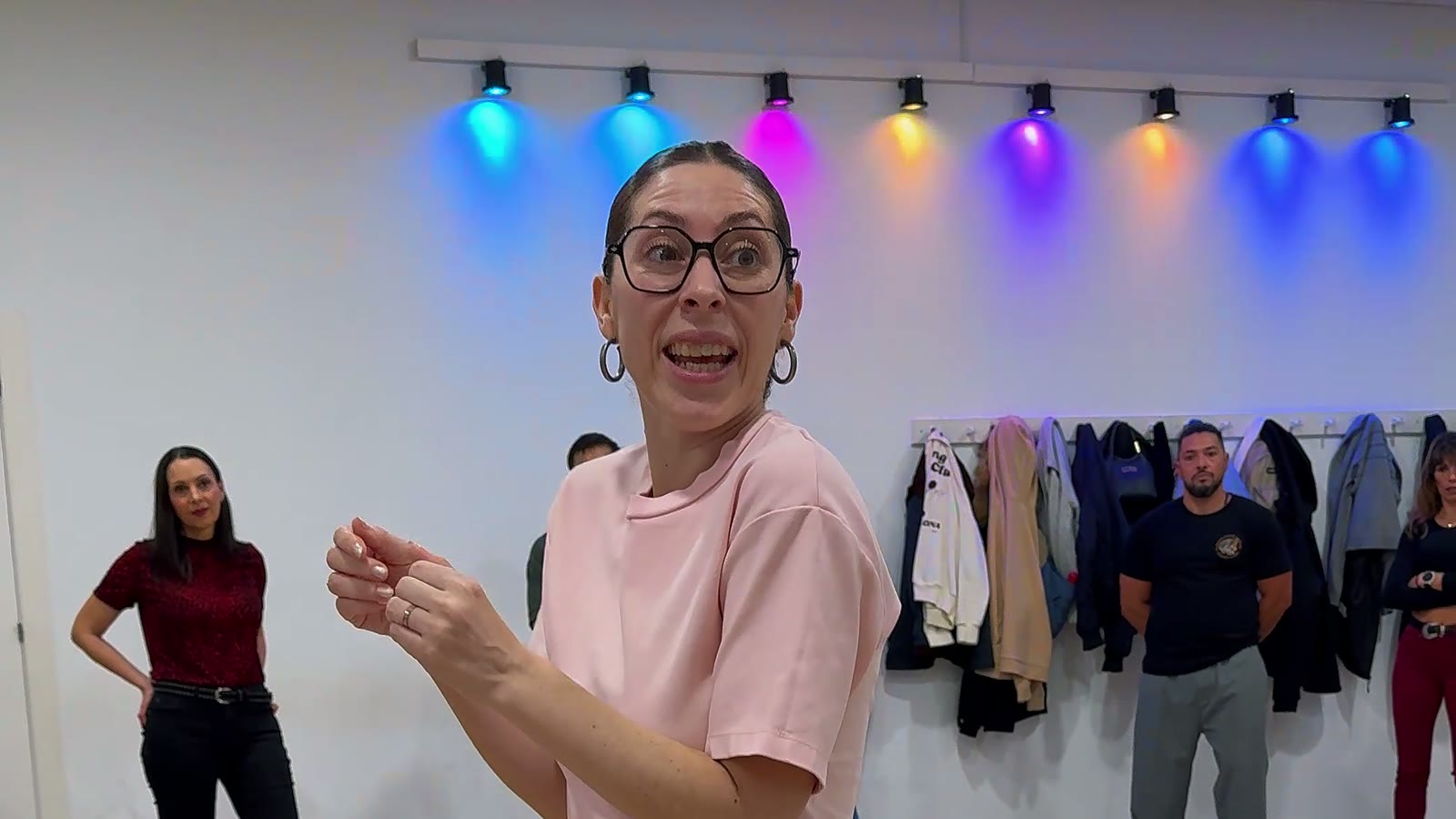
Bailar en pareja es que les salga a los dos, no que te salga a ti. Conectar con la otra persona vale más que cualquier figura. Es lo que trabajamos en nuestras clases de salsa en pareja en Málaga, y lo que Ceci explica en uno de los vídeos de nuestro canal de YouTube.
If it only works with your partner, you don't know how to lead yet
In our partner salsa classes we rotate. Someone always asks if it wouldn't be better to stay with the same person, because "it already works with her". That's exactly why we rotate: if a figure only works with one person, what you learned is how to dance with that person, not how to lead.
Rotating isn't going down a level. It's the opposite: it's where you really learn to dance with a partner.
The mistake: doing the same figures with everyone
As we progress, we want to add things. More turns, more figures, more arm styling, everything smoother. And we often do them the same way with everyone we dance with, at the same speed and with the same force, as if they were the same person.
That's when we forget the most important thing: the person in front of us. Not everyone goes at your pace, turns the same way or knows the same figures. If you speed up to fit everything in, the other person falls behind and the dance breaks.
A real leader adapts to each follower
A good leader isn't the one who leads the most turns. It's the one who has read their partner in the first few bars: how they move, what they understand, what speed feels comfortable. From there they choose what to do. Sometimes that means slowing down, leading more clearly or staying in the basic and enjoying the music.
When a figure works with one person, then another, then another, that's when you're learning to lead.
A real follower adapts to each leader
Following isn't doing the same thing every time either. Every leader is different: one prepares earlier, another leads more softly, another turns on a different beat. A follower who adapts listens to each lead instead of jumping ahead to what she thinks is coming.
And one thing is non-negotiable: keep stepping your basic. Often, in the rush to add arms or styling, we forget to step, and that's what the leader needs to be able to lead you.
Each one owns their role
The leader proposes, takes care and adapts. The follower listens, keeps her base and adapts. Neither of them dances alone. When each one owns their role, the dance stops being a list of figures and becomes a conversation.
How to practise it
- Rotate whenever you can: in class and at socials. Every new partner teaches you something your usual partner won't.
- Start with the basic: the first bars are for reading the other person, not for showing off.
- If you get stuck, go back to the base: breathe, slow down and start again. It's fine.
In short
Dancing with a partner means it works for both of you, not just for you. Connecting with the other person is worth more than any figure. It's what we work on in our partner salsa classes in Málaga, and what Ceci explains in one of the videos on our YouTube channel.